
How to Become an Electrician in New York (2026 Guide)
Last updated: July 2026
The short version
New York has no single statewide electrician license — New York City and each other city license their own electricians. The path is the same everywhere: meet the basics (18+, high school diploma or GED), complete a 4–5 year paid apprenticeship, log your on-the-job and classroom hours, then apply for a license where you plan to work. In NYC, the Master Electrician license requires about 7.5 years (10,500 hours) of experience and two exams through the Department of Buildings. Electricians in New York earn roughly $67,000 statewide and $85,000+ in New York City.
New York is one of the most rewarding places in the country to build a career as an electrician. From the skyscrapers of Manhattan and the data centers rising across the state to solar arrays and grid-modernization projects upstate, skilled electrical workers are in high demand — and they are paid accordingly. The catch is that becoming licensed in New York works differently from most states because there is no single statewide license. Instead, New York City and individual municipalities each run their own programs.
Don’t let that scare you off — the underlying path is consistent everywhere: get trained, earn supervised experience, and pass an exam in the jurisdiction where you want to work. This guide breaks down every step in detail, including a city-by-city look at how to actually get licensed across New York.
- Understanding New York's Electrician Licensing Landscape
- Prerequisites for Aspiring Electricians
- The Apprenticeship Path: Earn While You Learn
- Accumulating and Documenting Your Experience Hours
- Getting Licensed: A City-by-City Guide
- License Reciprocity in New York
- Continuing Education and License Renewal
- Becoming an Electrical Contractor or Business Owner
- Electrician Salary and Job Outlook in New York
- New York Electrician Licensing at a Glance
- Your Step-by-Step Checklist
- Frequently Asked Questions
- Final Thoughts
Understanding New York’s Electrician Licensing Landscape

The single most important thing to understand is that New York does not issue a statewide electrician license. There is no “New York State journeyman” or “New York State master” credential. Instead, licensing authority is delegated to cities and counties, and each sets its own rules. Depending on where you work, that affects:
- The license types offered (for example, master vs. special electrician).
- The experience and exam you’ll need.
- The fees and renewal requirements.
- Whether a nearby city will even recognize your license (usually it won’t).
Do You Actually Need to Be Licensed?
You do not need your own license to work as an electrician in New York. Most electricians spend years working legally under the supervision of a licensed master electrician. You need your own license mainly when you want to:
- Pull electrical permits in your own name.
- Run your own electrical contracting business.
- Supervise other electricians and sign off on work.
Prerequisites for Aspiring Electricians
Before you can join an apprenticeship, you’ll need to meet some baseline requirements. They vary slightly by program and city, but most New York paths expect:
- Age: At least 18 to start an apprenticeship. (Note: the NYC master license requires you to be at least 21.)
- Education: A high school diploma or GED.
- Math: Usually at least one year of high school algebra (Regents-level math).
- Residency: Some programs (notably IBEW Local 3) require residency in the Greater New York metro area before applying.
- Physical ability: Able to lift heavy materials, climb ladders, and work in confined spaces.
- Other: Legal authorization to work, ability to pass a drug screen, and often a valid driver’s license.
The Apprenticeship Path: Earn While You Learn
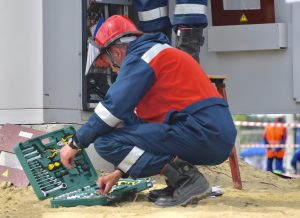
The heart of your training is a paid apprenticeship. Unlike college, an apprenticeship pays you a wage from day one and raises it as your skills grow — so you finish with experience and no debt. New York offers both union and non-union routes, and both build the experience you need to test for a license.
Union Apprenticeships (IBEW & NECA)
The best-known union path in New York City is run by IBEW Local 3 in partnership with the Joint Industry Board of the Electrical Industry. It’s a structured, roughly four-to-five-year program that includes:
- A minimum of 35 hours per week of paid on-the-job training.
- Several hours of related classroom instruction each week.
- College coursework toward an associate degree.
- Strong wages, health, and pension benefits — though entry is competitive.
IBEW locals operate across the entire state, each paired with a local Joint Apprenticeship and Training Committee (JATC). You can also browse registered programs through the New York State Department of Labor’s apprenticeship office.
Non-Union Apprenticeships (IEC & ABC)
If a union program isn’t the right fit, “open shop” (non-union) apprenticeships are widely available through the Independent Electrical Contractors (IEC), Associated Builders and Contractors (ABC), and individual contractors who sponsor state-registered apprentices. Compared with union programs, open-shop routes are often:
- Easier to start right away, with fewer waiting lists.
- More performance-driven — strong work can mean faster raises.
- More variable in pay and benefits, so track your hours carefully.
Trade Schools & Community Colleges
Certificate and associate-degree programs (including in the SUNY and CUNY systems) won’t license you on their own, but they can strengthen an apprenticeship application, count toward classroom hours, and give you a head start on theory and the National Electrical Code. Some registered degree programs can even reduce the experience required for the NYC master’s exam.
Accumulating and Documenting Your Experience Hours
Every New York path is built on documented, supervised experience. A standard apprenticeship provides roughly 8,000 hours of on-the-job training (four to five years) plus classroom instruction. For a full NYC Master Electrician license, the bar is higher — here’s how the experience requirement scales:
- No degree: about 7.5 years (10,500 hours) within the past 10 years.
- Graduate of a registered electrical program: about 5.5 years (7,700 hours).
- Bachelor’s degree (related field): about 3.5 years (4,900 hours).
- At least two years of experience must be in New York City.
Whatever your path, keep meticulous records — pay stubs, notarized letters from supervising licensed electricians, and detailed logs of the work you performed are exactly what the licensing board will ask to see.
Getting Licensed: A City-by-City Guide
New York City (Department of Buildings)
The NYC Department of Buildings (DOB) offers two electrical licenses: the Master Electrician License (required to pull permits and run your own contracting business) and the Special Electrician License (for an electrician who works exclusively for a single building owner). Here’s what the Master process looks like:
- Be at least 21 and able to read and write English.
- Experience: about 7.5 years (10,500 hours) under a licensed master or special electrician (reduced with an approved degree), including 2+ years in NYC.
- Written exam: multiple-choice, based on the NYC Electrical Code, passing score 70% — fee $585.
- Practical exam: pass within 24 months of your written exam notification — fee $530.
- Apply through DOB NOW: Licensing — as of February 23, 2026, paper and walk-in applications are no longer accepted.
The DOB publishes a detailed Master & Special Electrician application checklist (PDF). Because the written test is all about the code, a free NEC practice test is a great way to build the navigation speed you’ll need.
Buffalo
In the City of Buffalo, the Department of Permit and Inspection Services issues journeyman and master electrician licenses. Expect a documented experience requirement and a local licensing exam before you can pull permits or contract independently. Confirm current minimums and fees with the city, since they’re set locally.
Rochester & Syracuse
The City of Rochester and the City of Syracuse Central Permit Office each administer their own electrician licensing and exams, and both are specifically noted by the state as not sharing reciprocity with New York City or each other. In each, you’ll typically need documented journey-level experience and must pass a code-based examination. Check each city’s permitting office for the current application, experience requirement, and fee schedule.
Albany, Troy, Yonkers & Other Municipalities
The Capital Region and Lower Hudson Valley follow the same local-control pattern. The City of Albany issues permits to Class A and Class B licensed electricians, the City of Yonkers files electrical permits through its Department of Housing and Buildings, and the City of Troy publishes its own electrician-license requirements. The rule of thumb never changes:
- Confirm requirements with the local building or licensing department where the work will take place.
- Never assume a credential from one city carries over to another.
License Reciprocity in New York
New York is a tough state for reciprocity. Because there’s no statewide license, there’s no statewide agreement with other states — and the major cities generally do not honor each other’s licenses either. A few realities to plan around:
- NYC’s DOB does not accept out-of-state master electrician credentials.
- A license from Rochester, Syracuse, or Buffalo won’t automatically let you work in NYC or another New York city.
- If you plan to work across multiple jurisdictions, budget time and money to apply and test in each one.
Continuing Education and License Renewal
Earning your license isn’t the finish line — you have to keep it current. In New York City:
- The Master and Special Electrician licenses are subject to a three-year renewal cycle.
- Licensees must complete a DOB-approved 8-hour continuing-education course every year as a precondition of renewal.
- Keep your CE certificates on file — you’ll submit proof at renewal.
Other New York cities set their own renewal periods and CE rules, so confirm the schedule for your jurisdiction and don’t let your license lapse.
Becoming an Electrical Contractor or Business Owner
Many electricians’ ultimate goal is to run their own shop. In New York City, that requires the Master Electrician license, which lets you pull permits and file work in your own name. To operate legally, you’ll typically also need to:
- Register your business with the city and state.
- Carry general liability and workers’ compensation insurance.
- Comply with local contractor registration and tax rules (some cities issue a separate electrical contractor license in addition to the individual one).
Electrician Salary and Job Outlook in New York
New York is one of the highest-paying states for electricians. Pay depends heavily on your license level, whether you work union or non-union, and where in the state you’re based:
- Statewide average: about $67,000 per year.
- New York City: around $85,000 per year (about $41/hour) — roughly 22% above the national average.
- Union electricians often earn more once benefits like health care and pensions are factored in.
For reference, the U.S. Bureau of Labor Statistics reports a national median annual salary of $63,190 for electricians (May 2025), with the top 10% earning more than $108,510 and employment projected to grow about 9% through 2034 — faster than average. See our electrician salary guide for the full picture across experience levels.
New York Electrician Licensing at a Glance
| Jurisdiction | Who needs it | Key requirement | Where to apply |
|---|---|---|---|
| NYC Master Electrician | Permits / running an electrical business in NYC | 21+; ~7.5 yrs (10,500 hrs), 2+ in NYC; written ($585) + practical ($530) exams | NYC DOB (DOB NOW) |
| NYC Special Electrician | Electrical work for a single NYC building owner | Similar supervised experience + exams | NYC DOB (DOB NOW) |
| Buffalo | Working independently in Buffalo | Local experience + city exam (journeyman & master) | City of Buffalo |
| Rochester | Working independently in Rochester | Local experience + city exam | City of Rochester |
| Syracuse | Working independently in Syracuse | Local experience + city exam | Syracuse Central Permit Office |
| Albany / Yonkers / Troy | Working in those municipalities | Set locally (e.g., Albany Class A/B; some towns none) | Albany · Yonkers · Troy |
Your Step-by-Step Checklist
- Confirm the basics: 18+ (21+ for the NYC master license), high school diploma or GED, and a year of algebra.
- Decide where you want to work — NYC has the most defined path; check local rules elsewhere.
- Apply to an apprenticeship: union (IBEW Local 3 / a local JATC) or non-union (IEC, ABC, or a sponsoring contractor).
- Complete your on-the-job and classroom hours — and document everything.
- Accumulate the experience required by your target jurisdiction (up to 7.5 years/10,500 hours for the NYC master license).
- Apply through DOB NOW (or your local office) and pass the written and practical exams.
- Stay current with continuing education and renew on schedule.
Frequently Asked Questions
Final Thoughts
Becoming an electrician in New York takes patience and planning, but it is one of the most reliable paths to a stable, high-paying career — with no college debt required. The state’s local licensing system just adds one step: know where you want to work and follow that jurisdiction’s rules. Meet the basic requirements, land an apprenticeship that fits your goals, document every hour worked, and keep an eye on the license you’ll need. The demand for skilled electricians in New York has never been higher. Godspeed!
This article is for informational and educational purposes only. Licensing rules, fees, and procedures change often and vary by jurisdiction — always confirm current requirements with the New York City Department of Buildings or your local licensing authority before applying.


Get the Free Monthly Briefing
Licensing news, study tips, and the gear worth knowing about — plus a free Apprentice Logbook when you join. One useful email a month, no spam.
Join Free →