
The Education of an Electrician:
A Guide to Building a Powerful Foundation

If you are considering a career as an electrician, you are looking at one of the most stable and high-paying paths in the skilled trades. And now is the time to ensure your education prepares you for the challenges you’ll find there. Modern electrical work in 2026 requires a “hybrid” skillset: part construction, part engineering, and part computer science.
Building a strong foundation before you apply for an apprenticeship or trade school will significantly increase your chances of success. Here is a breakdown of the essential knowledge areas and skills you need, along with resources to help you master them.
NOTE: If you’re still in high school, you can seek out some of these skills in your classes, or maybe in a community college course. If you’re looking to make a career change, we’ve included links to educational resources that may be helpful.
- 1. Mathematical Proficiency: The Tradesman’s Calculator
- 2. Scientific Understanding: The Physics of Energy
- 3. Mechanical Aptitude and Technical Literacy
- 4. Safety Awareness and Code Compliance
- 5. Problem-Solving and Critical Thinking
- 6. Professionalism and Business Skills
- The First Step Toward a Powerful Career
1. Mathematical Proficiency: The Tradesman’s Calculator
In the electrical field, math is used to ensure that wires don’t overheat and buildings don’t catch fire. You must be comfortable with Algebra (to solve for unknown variables) and Geometry/Trigonometry (for physical installation and conduit bending).
- What is actually required: apprenticeship programs generally ask for one full year of high school algebra with a passing grade, not advanced mathematics, and the IBEW and NECA entrance battery tests algebra and functions rather than calculus. Our guide to the math you need to be an electrician sets out what each route asks for and what is on the entrance test.
- Helpful Resources:
- Khan Academy: Algebra 1: Focus on isolating variables and basic equations.
- Math for Electricians: Education specifically tailored to the trade.
- Mike Holt’s Illustrated Guide: Considered to be one of the best resources for electricians everywhere.
2. Scientific Understanding: The Physics of Energy
You need to understand the behavior of electrons, the basics of electromagnetism, and how materials react to heat. This “why” helps you troubleshoot a system rather than just replace parts.
- Key Concepts: Learn the difference between Direct Current (DC) and Alternating Current (AC), and understand Ohm’s Law (the relationship between Voltage, Current, and Resistance).
- Helpful Resources:
- All About Circuits: A free, high-quality website covering DC and AC theory.
- The Physics Classroom: Electricity: Great for visual learners to understand static vs. current electricity.
3. Mechanical Aptitude and Technical Literacy
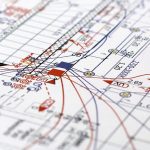
Electricians must translate complex 2D drawings into 3D installations. You need to be comfortable using tools and reading “architectural language.”
- Real-World Example: Looking at a blueprint, you see a small circle with three lines extending from it. You must instantly recognize that this is a three-way switch and understand how to wire it so the light can be controlled from two different locations.
- Helpful Resources:
- Ed2Go: Blueprint Reading Basics: A formal course that teaches you to navigate construction documents.
- Basic Electrical Hand Tools: A helpful video that goes over the most common tools used by electricians.
4. Safety Awareness and Code Compliance
Electrical work is inherently dangerous. A strong foundation includes an obsession with safety protocols and a respect for the National Electrical Code (NEC).
- The Standard: The NEC 2026 is the current regulatory document. You don’t need to memorize it, but you must know how to navigate its table of contents to find what you need fast.
- Helpful Resources:
- OSHA 10-Hour Construction Training: Most job sites require this. It covers fall protection, electrical safety, and personal protective equipment (PPE).
- NFPA 70: Free Access to the NEC: The official source for the electrical code, and there is a free version you can access to study.
5. Problem-Solving and Critical Thinking
Electricians are often called to fix systems that others couldn’t. This requires a logical, step-by-step diagnostic process.

- The Detective Process: If a circuit breaker keeps tripping, a good electrician doesn’t just put in a bigger breaker. They use a multimeter to check for a ground fault, a short circuit, or an overload. Through a process of elimination, they hunt down the problem and apply the fix!
- Helpful Resources: This is a general skill you learn by solving problems. Math is a great way to increase your abilities here, but it’s not the only way. Here are a few links to other resources that might be helpful.
6. Professionalism and Business Skills
Whether you work for a large company or start your own, communication and technical writing are an essential part of operating a business.
- Business Communication: You must clearly and professionally explain technical hazards to clients.
- Coursera: Business Communication (CU Boulder): Learn to lead teams and manage client relationships.
- Technical Writing: You will need to write “as-built” reports and detailed estimates.
- Oregon State University: Technical Writing Certificate: Excellent for learning how to create SOPs and safety manuals.
- Business Management: If you want to become a contractor, you need to understand labor laws and project estimation.
- NASCLA Contractor Training: Specifically for those looking to manage projects and hold a contractor’s license.
The First Step Toward a Powerful Career
Starting your journey into the electrical trade is a commitment to lifelong learning and precision. By focusing on these foundational skills in your education now, you aren’t just preparing for a job; you are ensuring that you have the knowledge and skills to not just succeed, but to thrive. All the resources you need are at your fingertips, so get to work! Godspeed!


Get the Free Monthly Briefing
Licensing news, study tips, and the gear worth knowing about — plus a free Apprentice Logbook when you join. One useful email a month, no spam.
Join Free →